
Precision Machining for Medical Devices: Ensuring Bio-Compatibility and Regulatory Compliance
Introduction: The Stakes of Medical Precision
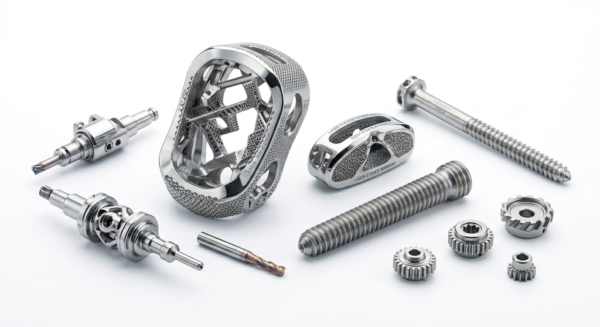
In the medical device industry, there is zero margin for error. Components ranging from orthopedic implants to surgical instrumentation require precision that exceeds standard industrial applications. The challenge for contract manufacturers is not just the micron-level tolerance on geometric dimensions, but the rigorous management of surface integrity and material purity. As global standards like ISO 13485 become the baseline, precision machining must be integrated with a robust quality management system (QMS) that ensures every part is safe for human implantation or surgical use.
The Engineering Challenges
Medical device manufacturing introduces unique constraints that differ significantly from aerospace or robotics:
Material Sensitivity: Many medical-grade materials, such as Titanium Grade 5 ELI, Cobalt-Chrome, and PEEK, react poorly to traditional cutting fluids. Contamination can render a component unsuitable for medical use.
Surface Finish and Bio-compatibility: Surface finish (Ra values) is not just a dimensional specification; it is critical for bone-implant osseointegration and reducing the risk of tissue inflammation.
Regulatory Documentation: A component without a validated process or full material traceability is, legally, a non-functional part.
Precision Machining Strategies: A Technical Deep-Dive
1. “Clean-Room” Machining Protocols
To prevent cross-contamination, we employ dedicated machining cells for medical components. This involves using water-soluble, biologically inert cutting fluids or, in some cases, dry-machining techniques. Every component is subjected to a validated multi-stage ultrasonic cleaning process to remove any traces of machining oil or metallic dust.
2. Advanced Surface Texturing
For orthopedic implants, the topography of the surface determines how the human body reacts to the device. We utilize controlled machining parameters and secondary processes (such as micro-bead blasting or passivization) to create surfaces that optimize cell adhesion while meeting specific anti-corrosion requirements.
3. Closed-Loop Validation
Unlike general manufacturing, medical device production requires a “frozen process.” Once a process is validated through IQ/OQ/PQ (Installation, Operational, and Performance Qualification), it cannot be altered without re-validation. Our digital manufacturing systems track every parameter of every part produced, ensuring 100% traceability from raw material lot to finished product.
Quality Assurance: Adhering to ISO 13485
Quality is not an afterthought; it is the product. Our facility operates under the strict guidelines of ISO 13485. Every stage of the manufacturing cycle is audited:
Raw Material Verification: Ensuring that every billet or bar matches the required medical-grade certification.
Non-Destructive Testing: Utilizing sophisticated inspection methods to detect micro-cracks or structural anomalies.
Full Documentation: Providing comprehensive Device History Records (DHR) to support our clients’ FDA/CE regulatory submissions.
Conclusion: A Partner for Life-Critical Components
Precision machining for medical devices is an exercise in trust. By aligning our technical capabilities with the strict regulatory requirements of the medical industry, we provide our partners with components that are not only dimensionally perfect but clinically safe. Whether you are developing the next generation of spinal systems or minimally invasive surgical tools, we offer the process stability and validated documentation required to accelerate your time-to-market.
Call-to-Action (CTA) :
“Are you looking to streamline your medical device supply chain with a partner that understands ISO 13485 compliance? Comment ‘ISO’ below or send me a DM, and I’ll share our guide on ‘Validated Manufacturing Processes for Orthopedic Implants’.”
Need a precision partner for your next clinical innovation? From high-complexity implants to precise surgical instrumentation, we are here to ensure your products meet the highest standards of safety and performance. 📩 Drop us a message here on LinkedIn or email your blueprints to [Insert Email] for a professional assessment. Let’s create medical solutions that make a difference.