
Achieving Sub-Micron Precision: Engineering High-Rigidity Components for Industrial Robotics
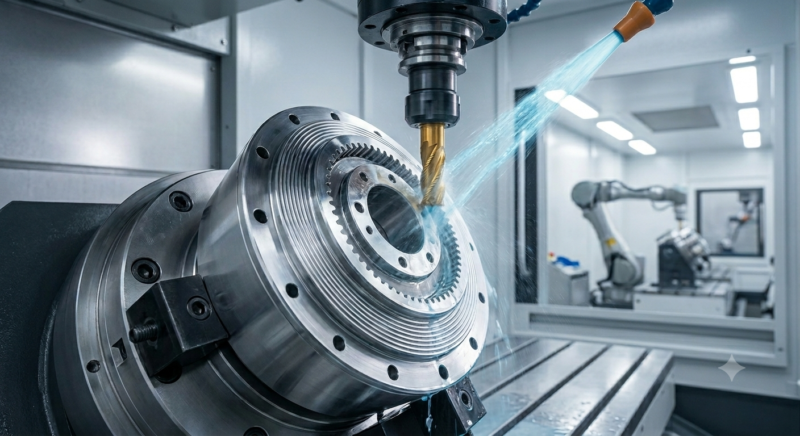
The Precision Requirement in Modern Robotics
In the era of Industry 4.0, the precision of a robotic arm is only as good as the sum of its machined components. Whether it is a high-speed pick-and-place robot or a delicate collaborative robot (cobot), the harmonic drives, gear housings, and joint spindles are the heart of the system. As cycle times decrease and payload requirements increase, the demand for sub-micron geometric tolerances and extreme material rigidity has shifted from “optional” to “critical.”
For precision machining manufacturers, the challenge lies in maintaining structural rigidity while achieving complex geometric shapes. A micro-deflection in a robot’s joint housing can result in a significant positioning error at the end-effector. Therefore, our machining strategy must focus on minimizing dynamic deflection and maximizing surface integrity.
Engineering Challenges: Dynamics and Rigidity
Machining components for industrial robotics presents unique engineering hurdles:
Dynamic Load Sensitivity: Unlike static structures, robotic components face constant acceleration and deceleration. Any machining-induced residual stress can lead to dimensional instability during high-frequency vibration.
Complex Geometric Tolerances (GD&T): Coaxiality and perpendicularity between joint axes are essential for smooth motion. Even a 5-micron deviation can cause catastrophic failure in high-torque gear systems.
Material Hardness vs. Machinability: High-strength steels and specialized alloys used for wear resistance in gear joints are notoriously difficult to machine to high-precision levels.
Precision Machining Strategies: A Technical Deep-Dive
1. High-Rigidity Fixturing for Multi-Axis Milling
To achieve sub-micron precision, traditional clamping is often insufficient due to part distortion. We utilize custom-engineered modular fixturing that supports the part at its most rigid points. By minimizing the “overhang” during the machining process, we ensure that the cutting tool forces are directed into the machine table rather than causing component deflection.
2. Advanced Surface Treatment and Hardening Coordination
For robot joints, wear resistance is as important as accuracy. We coordinate our machining process with advanced heat treatment (such as carburizing or induction hardening). We perform “pre-hardening” roughing and “post-hardening” finish grinding or hard-milling. This dual-stage approach ensures that the hardening-induced deformation is corrected during the finish-machining phase, guaranteeing the final geometry is perfect.
3. In-Process Automated Inspection
To eliminate the risk of human error, we integrate in-process probing on our 5-axis CNC centers. The machine probe measures the part before and after critical cuts, allowing the controller to make real-time tool-wear compensations. This loop ensures that the final part meets the drawing specifications without the need for multiple manual setups.
Quality Assurance: The Robot’s Lifecycle
A robot component’s value is its longevity. Our quality protocol includes:
Dynamic Balancing: Ensuring all rotating shafts and gear components are dynamically balanced to minimize vibration at high speeds.
Surface Integrity Analysis: Verifying Ra values to reduce friction and heat buildup in joint housings.
Traceability: Full documentation from raw material inspection to the final CMM report.
Conclusion: Engineering the Future of Automation
Precision machining for robotics is about enabling the machines of tomorrow to be faster, more accurate, and more reliable. By combining high-rigidity workholding, integrated heat-treatment workflows, and automated inspection, we provide components that push the performance envelope of your robotic systems.
Need a precision partner for your next high-stress robotics project? From high-torque joint housings to high-speed spindles, we have the expertise to help. 📩 Drop us a message here on LinkedIn or email your blueprints to [Insert Email] for a professional assessment. Let’s build the future of automation together.