

Accelerating Innovation: How DFMA Reduces Costs and Lead Times in CNC Machining
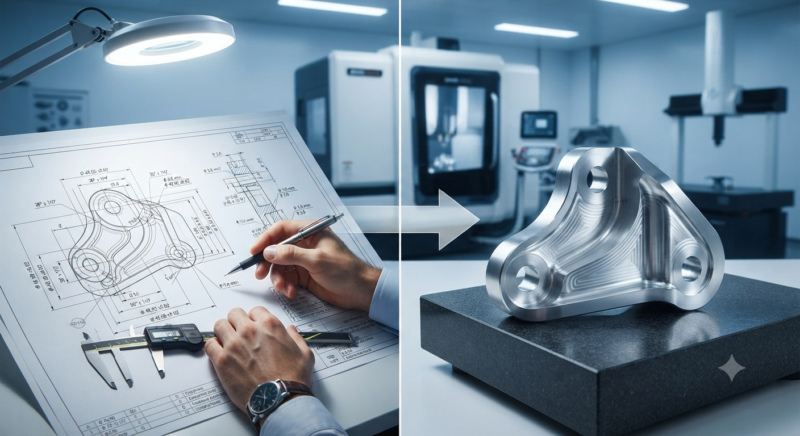
The Invisible Barrier to Market Entry
In the competitive landscape of precision engineering, the transition from a digital blueprint to a physical component is often where innovation hits a wall. For many product development teams—ranging from nimble startups in the medical device sector to established aerospace contractors—the “CNC prototyping” phase is frequently fraught with delays, budget overruns, and unexpected technical hurdles. The culprit is rarely the CNC machine itself, but rather a disconnect between design intent and manufacturing reality.
Enter Design for Manufacturing and Assembly (DFMA)—not just an engineering methodology, but a strategic imperative. DFMA is the art and science of aligning product design with the capabilities, constraints, and cost structures of the manufacturing process. By integrating DFMA principles into the earliest stages of product development, teams can eliminate waste, reduce the risk of failure, and drastically shorten the journey from a concept to a high-precision, small-batch reality. This article explores how TONGCRX leverages DFMA to turn complex engineering challenges into streamlined production success stories.
The Core Logic of DFMA: A Manufacturing-First Mindset
At its heart, DFMA is about asking the right questions before the first line of code is written in your CAM software. When we engage with clients at TONGCRX, our goal is to identify design features that, while aesthetically or theoretically sound, create unnecessary friction in the CNC environment.
1. Geometric Simplification: The Efficiency Multiplier
One of the most common drivers of cost in CNC machining is excessive tool engagement complexity. Features like extremely deep, narrow slots, internal radii that don’t match standard tool sizes, or blind holes with tight tolerance requirements all necessitate frequent tool changes, custom tooling, and slow feed rates.
The DFMA Solution: We work with design teams to standardize radii to match available end-mill diameters. By rounding internal corners rather than requiring sharp 90-degree internal transitions, we allow for higher-speed milling, which reduces cycle time and improves surface finish consistency.
2. Tolerance Optimization: Beyond the “Everything ±0.005mm” Trap
A frequent challenge we encounter is the “over-tolerancing” of drawings. Design engineers, striving for maximum quality, often apply ultra-tight tolerances (e.g., ±0.005mm) to every surface of a component. In reality, such tight tolerances are usually only necessary at critical mating surfaces or bearing interfaces.
The DFMA Solution: We categorize surfaces into “critical functional” and “non-critical aesthetic/clearance.” By applying looser tolerances to non-critical surfaces, we reduce the inspection burden and machine time by up to 30%, without impacting the component’s performance.
3. Material Utilization and Blank Optimization
Waste is an invisible cost in precision CNC machining. Machining a 50mm x 50mm x 50mm cube from a 100mm solid block of high-grade aerospace titanium or 17-4 PH stainless steel is financially inefficient.
The DFMA Solution: DFMA dictates that the raw material blank should be as close as possible to the final part’s envelope. We advise clients on the optimal raw material sizing to minimize material removal volume, which not only lowers the bill of materials but also extends tool life by reducing the total time the tool spends in cut.
The Value of DFMA in Small-Batch Prototyping
When clients seek our help for small-batch prototyping, they are often on a race against time. DFMA is the engine that drives this speed.
Poka-Yoke (Error Proofing): By integrating design-based error proofing, we ensure that parts cannot be assembled incorrectly. For instance, asymmetric mounting holes ensure that a housing is always oriented correctly, reducing the risk of costly post-assembly failure.
Reducing Secondary Operations: Through integrated design, we often find ways to combine two or three separate parts into a single monolithic component. This eliminates the need for welding, bolting, or adhesives, which in turn reduces the need for assembly jigs, quality inspection stages for separate parts, and assembly labor.
TONGCRX’s Collaborative Engineering Approach
At TONGCRX, our engineering team operates on the philosophy that a drawing is a dialogue. Our DFM-focused review process consists of three distinct phases:
Manufacturing Feasibility Assessment: Upon receiving your CAD files, our senior process engineers conduct a proactive “Design Review.” We look for features that are prone to deflection, chatter, or thermal deformation.
Material-Process Alignment: Choosing the right alloy is only half the battle; choosing the right machining strategy for that alloy is the other. Whether it’s 5-axis simultaneous milling for complex geometries or turning for cylindrical components, we match your design with the most efficient machine configuration.
Alternative Path Analysis: Sometimes, the most efficient way to manufacture a part isn’t CNC machining alone. We provide clients with honest assessments on when to pivot to other processes—such as combining additive manufacturing for initial prototypes with CNC machining for final precision features. This hybrid approach often provides the best balance of speed and dimensional accuracy.
Addressing the Metallurgical Challenges of Exotic Alloys
DFMA is particularly crucial when dealing with “exotic” materials like titanium alloys or nickel-based superalloys (e.g., Inconel). Because these materials are work-hardening and have poor thermal conductivity, the design must account for tool access and cooling application. If a feature is too deep, the coolant cannot reach the cutting edge, leading to catastrophic tool failure. Our DFM review ensures that your design allows for high-pressure coolant access, which is the only way to achieve high-precision results on these resilient materials.
Quality Assurance: The DFMA Legacy
The beauty of a DFMA-optimized design is that it is inherently easier to inspect. When critical surfaces are clearly identified and unnecessary complexity is stripped away, our Quality Assurance teams can focus their high-precision CMM (Coordinate Measuring Machine) efforts on the features that truly determine the part’s performance. This leads to a higher “First Pass Yield” (FPY), ensuring that your parts are delivered right the first time, every time.
Turning Technical Challenges into Competitive Advantages
DFMA is not about restricting design freedom; it is about empowering designers with the knowledge of what is possible. By partnering with TONGCRX, you aren’t just sending a file to a machine; you are engaging an engineering team that understands the physics of production. A DFMA-optimized design is a design that is ready for the market—cost-effective, reliable, and manufacturable.
If your current design project is facing the hurdles of tight budgets or aggressive delivery schedules, we invite you to take advantage of our collaborative engineering expertise. Let us conduct a complimentary DFM feasibility assessment on your next design.
Next Blog:
Mastering the Machining of Exotic Alloys: Advanced Strategies for Titanium and Superalloys

The Evolution of Titanium Machining: Optimizing Cutting Strategies for Aerospace Grade 5 & 23
June 9, 2026
No Comments
Read More » 
The Art of Tolerance: Mastering Sub-Micron Precision in CNC Machining
July 6, 2026
No Comments
Read More » 
The Art of Precision: Why High-Tolerance Machining is the Backbone of Modern Innovation
April 15, 2026
No Comments
Read More » 
Solving Strict Tolerances in Complex Surgical Instruments with 5-Axis CNC Machining
May 14, 2026
No Comments
Read More »