
Mastering Residual Stress: Preventing Distortion in Thin-Wall Aluminum Aerospace Components
Introduction: The Invisible Enemy of Thin-Wall Precision
In the relentless pursuit of aerospace performance, engineers constantly push the limits of material efficiency, demanding complex, lightweight structural components . Thin-wall aluminum parts, such as bulkheads, ribs, and spars, are vital for reducing the overall weight of aircraft structures . However, these very components present one of the most formidable challenges in precision machining: distortion caused by residual stress .
For aerospace manufacturers, achieving the required geometric tolerances is not just about the final cut ; it is about managing the internal balance of the material from the raw forged or billet state to the finished part . Residual stresses—internal stresses that remain after the original cause (such as thermal gradients during forging, cold working, or uneven cooling) has been removed—can cause critical components to twist, warp, or change dimension long after machining is complete . This invisible enemy can compromise the structural integrity,anti-fatigue life, and safety of aircraft assemblies .
The Mechanics of Distortion: Understanding Residual Stress
To successfully machine thin-wall aluminum components, we must first understand the two primary sources of residual stress:
Thermal Stress: Induced during the initial material manufacturing processes, such as quenching after heat treatment, which creates significant thermal gradients and tensile stresses within the part’s core .
Machining-Induced Stress: Mechanical working and localized heating during the cutting process create fresh tensile or compressive stresses on the new surface, which, when unbalanced across a thin cross-section, cause it to deform .
Precision Machining Strategies: A Holistic Approach to Stress Management
Mastering residual stress requires a holistic engineering approach that starts long before the final finished dimensions are achieved . Our facility integrates several critical technical strategies :
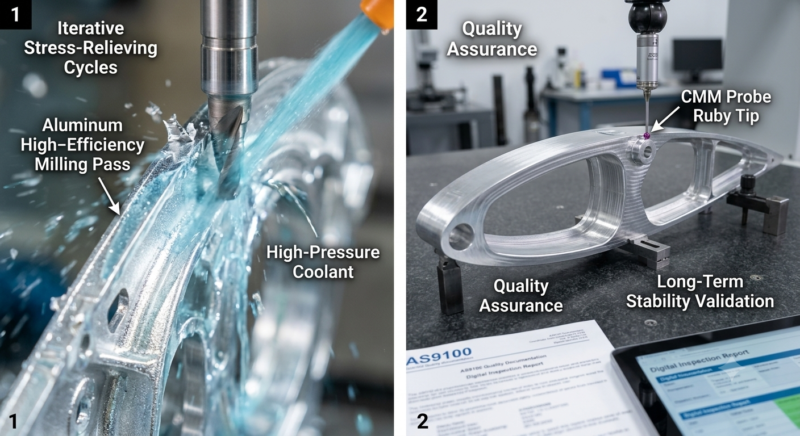
1. Iterative Stress-Relieving Cycles
We do not attempt to machine to final dimensions in a single step . For high-material-removal parts, we employ a phased approach :
Rough Machining: Remove up to 80% of the bulk material, allowing the part to “move” and relieve core tensile stresses.
Interstage Stress Relieving: Perform controlled thermal treatment (e.g., artificial aging) or vibration stress relief between roughing and finishing.
Semi-Finishing: Achieve dimensions close to final to establish geometric dimensioning and tolerancing (GD&T) stability .
Finish Machining: Final critical cuts to achieve micron-level tolerances and required surface integrity .
2. Specialized Cutting Tool Geometries
We utilize tools specifically engineered for low-force cutting. Sharp cutting edges and optimized rake angles reduce localized cutting forces and work hardening, which, in turn, minimizes fresh machining-induced stresses on the new surface . The use of advanced coatings also helps to manage heat, further preventing localized thermal gradients .
3. Innovative Workholding and Distortion Prevention
Perhaps the most crucial, yet overlooked, element is workholding. For thin-wall components, traditional rigid clamping must be avoided . We utilize innovative strategies such as:
Iterative Re-Clamping: Loosening and retightening clamps between machining phases to allow for natural stress redistribution .
Low-Force Fixturing: Using vacuum tables or balanced support systems that minimize external mechanical forces on the delicate part during the cut .
Quality Assurance: Long-Term Stability Validation
In aerospace contract manufacturing, the final check is not just about measuring tolerances at one point in time . Our protocol includes :
GD&T Verification via CMM: Full 3D inspection to ensure all critical tolerances and surface finish (Ra values) meet AS9100 standards .
Long-Term Stability Testing: Submitting sample parts to thermal cycles (accelerated aging) to validate that dimensions remain stable under operating conditions, a crucial anti-fatigue performance metric .
Conclusion: Engineering Structural Integrity
Mastering residual stress in thin-wall aluminum machining is not about luck; it is about engineering-led process control . By understanding the material’s behavior under stress and implementing a rigorous process of iterative stress relief, innovative fixturing, and stabilized machining , we provide our partners with thin-wall components that are dimensionally stable, dimensionally accurate, and structurally sound for critical aerospace applications .
For aerospace engineering teams facing the challenges of warpage and long lead times with critical aluminum structures, a Design for Manufacturability (DFM) collaboration is essential . We invite you to discuss your upcoming thin-wall structure challenges with our technical specialists .