
The Evolution of Titanium Machining: Optimizing Cutting Strategies for Aerospace Grade 5 & 23
Introduction: The Titanium Paradox in Aerospace
Titanium alloys, particularly Ti-6Al-4V (Grade 5) and Ti-6Al-4V ELI (Grade 23), have become the backbone of modern aerospace structural components. Their unparalleled strength-to-weight ratio and exceptional corrosion resistance make them indispensable for airframes, landing gear, and engine components. However, this same physical robustness presents a “paradox” for precision machinists: the very properties that make titanium ideal for flight make it exceptionally difficult to machine.
For precision manufacturers, the challenge lies in titanium’s low thermal conductivity and high chemical reactivity at elevated temperatures. When machining these alloys, heat does not dissipate into the chips effectively; instead, it concentrates at the cutting edge. This leads to premature tool failure, work hardening, and surface integrity issues that can compromise the safety-critical nature of aerospace parts.
The Engineering Challenges
To produce aerospace-grade titanium components, one must master three critical variables:
Work Hardening: Titanium alloys tend to work-harden rapidly. If the tool is not cutting cleanly and consistently, the material surface becomes harder than the cutting edge itself, leading to rapid tool degradation.
Thermal Management: With thermal conductivity roughly 1/6th that of steel, the cutting heat is trapped at the contact zone.
Vibration and Chatter: Due to the stiffness requirements of aerospace designs, we often deal with thin-walled structures where chatter is the primary enemy of precision.
Precision Machining Strategies: A Technical Deep-Dive
1. High-Efficiency Milling (HEM) and Trochoidal Strategies
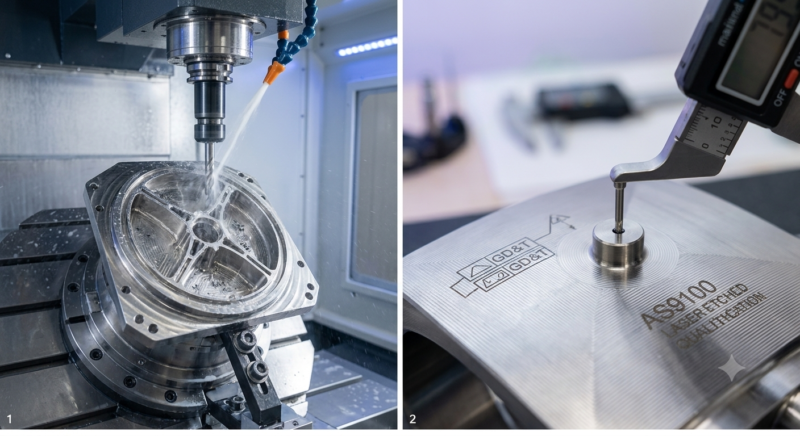
Traditional milling strategies often fall short when dealing with titanium. At our facility, we have shifted focus to Trochoidal Milling and Dynamic Milling. By maintaining a constant engagement angle and utilizing a smaller radial depth of cut with a larger axial depth of cut, we distribute the heat across a larger portion of the tool flute. This approach allows us to maintain higher cutting speeds while keeping the thermal load per tooth within a manageable threshold.
2. Advanced Tooling Geometries
Standard carbide tools are often insufficient for Grade 5 and 23. We utilize PVD-coated carbide tools with specialized micro-geometries. Specifically, tools with variable helix angles help to break up harmonic vibrations, which is vital when machining thin-walled aerospace ribs. Furthermore, the use of chip-splitters (wave patterns) on the cutting edge can help segment the chips, preventing the “bird-nesting” effect that often leads to surface scoring.
3. High-Pressure Coolant (HPC) Systems
Cooling is not just about temperature reduction; it is about chip evacuation. We utilize high-pressure coolant directed precisely at the shear zone. This does two things:
It blasts the chips away before they can be re-cut, preventing chip-welding.
It creates a thermal barrier that prevents the tool from reaching critical temperatures that degrade its coating.
Quality Assurance: Beyond the CAD Model
In aerospace, the machining process is only half the battle. The other half is ensuring that the Residual Stress induced by machining is within tolerance. We employ iterative stress-relieving cycles during the machining process, especially for parts that undergo significant material removal (e.g., from a forged block to a lightweight rib).
Our quality control protocol involves:
CMM Inspection: Verification against 3D CAD data with micron-level tolerances.
Surface Integrity Analysis: Ensuring that the feed marks and surface finish (Ra values) meet the stringent anti-fatigue requirements of aero-structure standards.
Traceability: Every batch of material is mapped to its heat number, and every process step is logged for full documentation, meeting AS9100 standards.
Conclusion: Partnering for Aerospace Precision
Precision machining for aerospace is not merely about removing metal; it is about managing material behavior under stress. By integrating advanced trochoidal cutting strategies, optimized coolant management, and a rigorous approach to residual stress, we provide our partners with components that do not just meet the drawing specifications—they enhance the structural integrity of the final aircraft.
For engineering teams looking to reduce lead times and improve part reliability, the key lies in the upfront design-for-manufacturability (DFM) collaboration. We invite you to review your upcoming aerospace projects with our engineering team to explore how our specialized titanium machining strategies can optimize your production cycle.
If your team is struggling with Ti-6Al-4V work hardening issues, let’s discuss some toolpath optimizations